
Hack your SEO on TikTok in 9 Steps

Use these 9 simple steps to boost your TikTok SEO and broaden your exposure! Discover how to enhance your content and climb the search results. Watch your videos rise in the rankings by utilizing the strength of TikTok's search algorithm.
seo-on-tiktok-growthgirls

Introducing SEO on TikTok

Are you looking to boost your visibility and reach on TikTok? Harnessing the power of SEO on TikTok can be the key to optimizing your content and expanding your audience.TikTok’s search engine features provide you a great chance to improve your visibility and engage with consumers who are actively looking for information and products thanks to the platform’s millions of active users. 

Prepare to boost your online visibility on TikTok with efficient SEO strategies designed specifically for the platform’s distinct environment. SEO on TikTok includes effective SEO capabilities that might propel your material to new heights. In fact, according to studies, an astonishing 40% of Gen Z users frequently use TikTok as a search engine to quickly discover products and information. When that happens, SEO’s power truly manifests itself.

@growthgirls

Hack your SEO strategy on TikTok. So, you may wonder what does TikTok have to do with SEO? TikTok actually has Search Engine features. It will suggest keywords both in the search bar and in the comment section. Are people using it? Yes, they are. According to recent studies, 40 % of Gen Z are using TikTok as a search engine. That means that if they’re looking for a product, they may go to TikTok to search for it. So here’s what you need to do to help the TikTok algorithm serve your content to your target audience. First, you need to start with making a keyword list. If you have an SEO strategy, then you have a keyword list as well. But if you don’t, now is the time to create. Select words that best describe what you offer. We will call them your base keywords. Select one of your base keywords and put them in the search bar. See what other keywords TikTok suggests. You may want to create a video around one of those keywords. After you’ ve selected your keyword, now it’s the time to start filming. You want to make sure you save the keywords within the first few seconds. I will let you know why later. After you’re done filming, you need to place your keyword in three places. 1. In the caption. As of September 2022, you can now have up to 2000 words, so make sure your keyword is one of them. 2. The second place you want to have your keyword is in the automated closed captions. See why you must say your keyword within the first few seconds? 3. The third place is the onscreen text. That’s it! Follow me for more Growth Hacks.

♬ original sound – GrowthGirls

What is SEO on TikTok?

SEO on TikTok is the process of optimizing your TikTok content to increase its discoverability on the site and gain more views, likes, and followers. This is achieved through investigating hashtags, focusing on certain terms, and utilizing well-liked platform trends.

TikTok videos have the potential to rank in Google search results, so you may expand your audience and exposure by optimizing your material for SEO.

For digital marketers and content producers, search engine optimization SEO is not a new concept, but applying it on TikTok opens up a world of opportunities. So, just how can you leverage your TikTok SEO approach to increase visibility? 

For people and organizations wishing to enhance their visibility and accomplish certain marketing goals on the well-known social media app, a TikTok growth plan is important. 

But why exactly is a growth plan required?

A thoughtful growth plan makes sure that you provide quality leads for your company. TikTok’s large user base and interesting content forms can help you draw in new clients and pique their interest in your goods or services.

TikTok has the potential to be a significant traffic generator for your website. You may deliberately drive visitors to your targeted internet locations, where they can find out more about your business or make a purchase, by inserting links to your website or landing pages in your TikTok content.

How can you leverage TikTok’s enormous capacity to accelerate the development of your brand?

Here is a list of steps to ensure that your videos appear in searches

Optimize your profile first

Your TikTok profile acts as a digital business card, so it’s critical to make a good impression on prospective clients right away. Follow these measures to enhance your profile and make it appealing:

  • Choose a distinctive username that accurately represents your brand and is simple to remember. In order to show up in keyword searches, this username should also be pertinent to your expertise. 
  • Pick a name: Your username should be aligned with the name area of your profile, which is found above your profile photo. Your profile will show up in search results as a consequence. 
  • Utilize a beautiful profile picture. A visually appealing logo may be useful for companies.
  • Create an appealing bio: Write a brief and captivating bio that uses no more than four words, to sum up what your brand does. Include a four-word call to action that guides users in a certain direction. Emojis may be added to your bio to add personality and make it more interesting.
  • Put a link in your bio: Use the link in the bio tool to direct visitors to your preferred websites. Links to various websites, online stores, and social media accounts are all permissible. If you have an Instagram or YouTube account, you may also post links to those platforms to increase your online visibility.

Always remember to update your profile on a frequent basis to reflect any changes to your brand or product offers.

Follow the most recent trends

You may see many videos using the same music in quick succession thanks to TikTok’s superpower of trends. Why? Mostly because it’s fashionable! You may take advantage of app trends to expand your business by using them to your benefit. How do you discover what’s popular? In order to produce content with hot hashtags, visit the discovery tab and look for them there. 

88% of TikTokers say the audio is “essential” to their overall experience on the app — and it’s also essential for SEO on TikTok.

Watch the platform, follow well-known creators, and interact with the community to remain up to date on the newest fashions. Being a trendsetter allows you to position your material to immediately get momentum and reach a larger audience. 

Find the most popular songs being utilized on TikTok by using the Billboard Hot 100 ranking. Over 175 TikTok hot songs from 2021 were included in this list.

Billboard hot 100 list of songs SEO on TikTok

Work with the TikTok creators

One of the simplest methods to expand your brand on TikTok has got to be through collaborating with creators. You will be dealing with people who have already established a community, and that’s the only explanation. In other words, you will just be utilizing their power over their audience. Maybe that’s why this technique is often called “influencer marketing.” How do you locate creators with whom to work? Utilizing a creator marketplace like the one on TikTok.

Utilize your analytical data

TikTok analytics is a potent tool that offers insightful data on how well your profile and content work. You may improve your TikTok approach by subscribing to a Pro account, using this data, and getting a better insight of your audience. Here are some tips for maximizing your TikTok analytics:

  • Upgrade to a Pro account: 
  • Analyze the demographics of your audience
  • Follow video performance
  • Investigate content insights
  • Check out hot content and hashtags using TikTok analytics

Engage in challenges

Similar to trends, challenges need active engagement from companies, groups, and everyday consumers. A TikTok challenge is just an invitation to participate in a competition.  TikTok has the option to share your material with other challenge participants by promoting your high-quality challenge videos.

In addition to presenting them, you might be able to persuade other individuals to participate, which would result in greater engagement and brand visibility for you.  

The #BottleCapChallenge on TikTok has been a hit. This challenge went viral on social media and became a worldwide phenomenon. The task required the participant to use a spinning kick, frequently executed with martial arts or athletic flare, to unscrew a bottle cap.

Users from all around the world participated in the #BottleCapChallenge and uploaded videos to TikTok, which helped the challenge achieve enormous popularity. Celebrities, sportsmen, and even regular people participated and displayed their talents as the fad spread quickly.

In addition to entertaining the audience, the event gave participants a chance to show off their bottle cap-kick skills and ingenuity. It offered a lighthearted and interesting approach to interacting with a large audience and sparked interest in the site.

@michaelfallon

#bottlecapchallenge Everyone Online vs. Me..🍾😂 (NAILED IT!!)

♬ original sound – Michael Fallon

Post at the right time

When trying to increase your TikTok audience and interaction, timing is essential. You may enhance the probability that your followers and the larger TikTok community will notice your content by publishing your videos at the ideal time. 

  • Understand your audience’s habits: It’s important to know how and when your audience uses TikTok. This will change based on the demographics and time zones of your particular audience.
  • Play around with the publishing times: When you have a basic sense of when your audience is most active, try publishing at various times to see which ones get the most interaction. Track the success of your videos and experiment with publishing at various times of the day. 
  • Consider the busiest times: In general, TikTok experiences peak usage during periods when a greater number of users are engaged on the site. The evenings and weekends, when people have more free time, are typical TikTok usage peaks. 
  • Be dependable: On TikTok, consistency is crucial. By consistently posting at the proper times, you can teach your audience to anticipate and enjoy your material, which will increase the chance of engagement and help you develop a devoted following.

Target keywords

Choosing carefully the terms users are using to look for on the site is a useful TikTok growth tip. You can make sure you’re catering to your target audience’s interests and improve the likelihood that people will find your videos by developing content based on these keywords.

On TikTok, it is simple to find pertinent terms. Observe the recommended terms that are displayed after starting to type in the search window. Make a note of the keywords that apply to your topic or material and include them in your concepts for videos. Your content’s visibility can be improved and you can reach more users who are actively looking for that information by aligning it with these keywords.
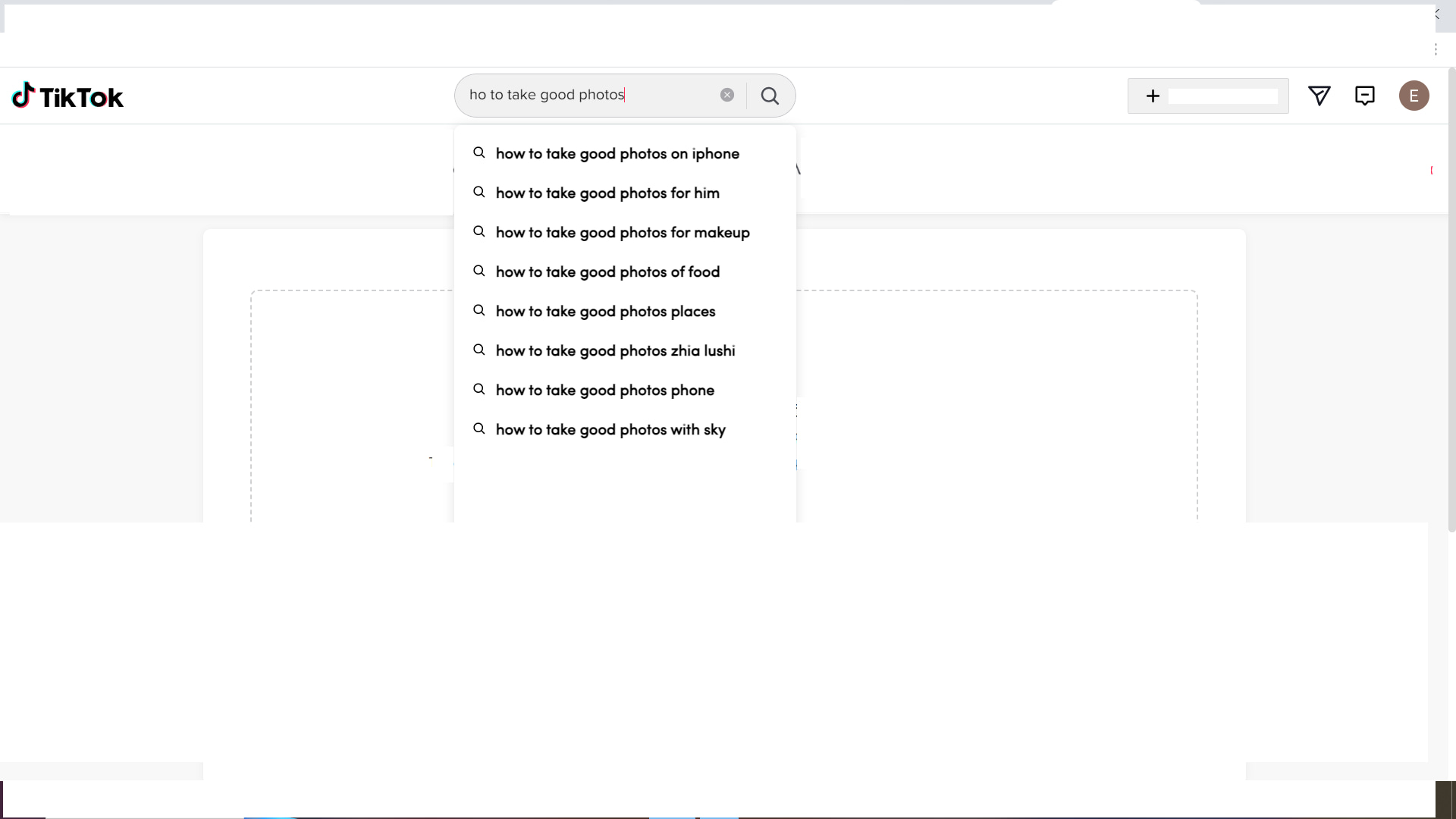
How to take photos search on tiktok

Include keywords in your content

Once you’ve finished your TikTok keyword research, start incorporating them into your content in the videos’ titles, descriptions, and subtitles. This includes any text that appears on the screen, such as song lyrics or explanations.

Also, make sure you pronounce the terms aloud! Yes, TikTok’s algorithms give videos with genuine keyword speech a higher ranking. 

In order to make it easier for people to locate your posts, you should also include your keywords in any hashtags you use. Use both your primary keyword and any logical variants of it. But don’t go overboard. Make sure you are aware of the ideal hashtag usage for each platform.

Finally, include in your TikTok profile the most pertinent target keywords. When people search for these terms, your profile will be more prominent as a result. Additionally, it helps potential followers decide whether or not to follow you by letting them know what sort of content you produce.

Benefit from SEO on TikTok

You may utilize a variety of TikTok SEO techniques to leverage or optimize your videos so they receive more views. In other words, it may aid in the virality of your postings by employing various techniques that will place your video content at the top of TikTok’s search results.

Why is this crucial?

It’s because more individuals are using TikTok to conduct searches instead of Google. 

Therefore, you need to make sure your videos appear at the top of TikTok’s search page, exactly like Google’s SERP.

How does SEO on TikTok work?

There are three main elements in a video that you should keep in mind:

  • Speech or audio 
  • Captions 
  • Description

Remember that experts suggest it’s best to verbalize your keyword in the first few seconds of your video to get TikTok’s attention.

@skinbyhelen

No more retinol scaries with the iconic RoC Retinol Capsules @RoC Skincare #paidad #RoCRetinol #Retinol

♬ Hip Hop with impressive piano sound(793766) – Dusty Sky

Making use of TikTok’s advantages and implementing SEO tactics to increase your visibility may drastically change the way people see your company. You may discover new ways to increase your reach, interact with your target audience, and provide measurable results by using Tiktok’s keyword SEO as your guide. Each growth hack, whether it be through profile optimization, leveraging trending hashtags, collaborating with other TikTok producers, or examining your data, is crucial to maximizing your TikTok potential.

Start using these TikTok growth strategies straight away. Recognize the opportunity of SEO on TikTok as your account gains velocity, engagement increases, and your business grows in this everchanging social media ecosystem.

Keep up with trends, make adjustments as they appear, and let the TikTok community expand your business. Remember that there are endless opportunities when you combine the tactical power of SEO on TikTok.

Grow your TikTok presence alongside your other social channels by getting in touch with Growthgirls

One value bomb per month

Subscription implies consent to our privacy policy

YOU MIGHT ALSO LIKE

What Q1 teaches us about buyer behaviour

Most teams are stuck in AI limbo: endlessly trialing shiny tools, collecting anecdotes, and struggling to show impact. Growth teams know this movie. Every new channel looks promising until you put it through the grinder: define success, test small, measure hard, keep what compounds. That same mindset is exactly how to turn AI experiments into strategy.

Here’s a practical playbook to replace random AI tinkering with a focused, measurable roadmap. You’ll set a clear North Star, turn everyday bottlenecks into a prioritized backlog, design rigorous tests that stand up to scrutiny, and convert wins into repeatable playbooks and governance. Less hype. More compounding value.

Start with a single AI North Star

AI has many potential benefits, but a strategy that tries to optimize for everything optimizes for nothing. Pick one North Star that your AI program exists to move. You can (and will) influence other metrics over time, but you need a single primary outcome to guide priorities and tradeoffs.

In practice, your North Star will usually sit in one of three categories: Efficiency, Revenue, or Quality. An efficient North Star focuses on reducing cycle time, cost per output, or headcount hours; for example, improving time-to-ship content, lowering cost per lead response, or increasing tickets handled per agent. A revenue North Star aims to grow acquisition, conversion, or expansion, using metrics like qualified meetings booked, trial-to-paid conversion, or uplift in average order value. A quality North Star is about improving accuracy, consistency, or brand fit, tracked through editor quality scores, compliance pass rate, or CSAT/NPS for AI-assisted interactions.

Make it concrete. Define a specific metric and how it’s calculated, a baseline (current performance) and a target (e.g., a 20% cycle-time reduction within 90 days), and the scope: which team, process, and data sources are in play. This Anchor Metric will prevent scattered efforts and help you say “not now” to experiments that don’t ladder up.

Turn bottlenecks into an experiment backlog

Growth teams don’t hunt for features to use in random tools; they hunt for friction. Ask: Where does work get stuck? What is repetitive, slow, error-prone, or expensive? Inventory real-world bottlenecks, then translate them into experiment candidates.

How to build the backlog:

  • Shadow your process for two weeks. Capture tasks with high frequency and high pain (measured by time, cost, or error rate).
  • Pull data. Look at cycle-time reports, ticket tags, SLA breaches, content queues, and handoff delays.
  • Ask front-line employees where they copy/paste, rework, or wait the most.
  • Map steps with clear inputs and outputs. You want tasks where success is observable, not subjective wish-casting.

For each candidate, document:

  • Problem statement and business impact
  • Current baseline (time, cost, quality)
  • Volume (per week/month)
  • Risks and constraints (compliance, brand, accuracy)
  • Hypothesis for AI-assisted improvement
  • Potential metric(s) tied to your North Star

Prioritize with an AI-tailored ICE+R score:

  • Impact: Estimated movement on the North Star if successful.
  • Confidence: Data quality, feasibility, existing proofs, and team skill.
  • Effort: People-hours to test, not to fully implement.
  • Risk: Reputational, legal, privacy, or safety risk if the test fails.

Score objectively, pick the top 3-5, and queue everything else. This creates focus and visible tradeoffs.

Design simple but rigorous experiments

Your goal is to learn fast without fooling yourself, so resist the urge to “just try it and see”. Treat each experiment like a tiny product launch, with an explicit hypothesis, a solid baseline, and a clear decision rule

Start by defining the problem: which bottleneck are you addressing and for whom? Then write a hypothesis in the form: “If we introduce [AI intervention], then [North Star metric] will improve by [X%] because [reason].” 

Spell out the scope and workflow by clarifying which steps are AI-assisted versus human and what human-in-the-loop looks like. Capture the baseline by measuring current performance on primary and guardrail metrics over a recent sample.

From there, define your metrics: a primary metric tied directly to your North Star, secondary diagnostic measures like throughput or turnaround time, and guardrails such as quality, compliance, or customer satisfaction thresholds that must not drop. 

Decide on the sample and duration; how many items or days you need and use a control group where feasible. Set success criteria and a decision rule in advance (ship, iterate, or kill), and build a cost model that includes all-in cost per output, from tool APIs and platform seats to human review time. 

Finally, document risks and governance: data sensitivity, model policies, and how failures are handled. For generative AI specifically, define a quality rubric; “looks good” isn’t a metric. Use a 1-5 scale aligned to brand and accuracy (tone, factuality, completeness, compliance), pairwise comparisons against baseline content or responses, LLM-as-judge as a triage proxy with human spot checks for calibration, and hallucination and policy checks such as required disclaimers.

An example experiment

In this example, the backlog item is SEO brief creation for the content team. 

The problem is that senior strategists spend 90 minutes per brief, with a volume of 40 per month, which slows publishing and ties up high-cost talent

The North Star is Efficiency, with a target of a 50% cycle-time reduction and no drop in editorial quality

The hypothesisis: if we use an AI system to generate a first-draft brief (keywords, outline, questions, internal links), human editors can produce final briefs in under 45 minutes with equal or better quality

The baseline is a time per brief of 90 minutes (median of the last 20), a quality score of 4.3/5 on the editor rubric, and a cost per brief of $X labor cost

The metrics are: Primary: time per brief; Secondary: cost per brief; and Guardrails: quality must be ≥ 4.3/5, factual errors = 0, and brand/tone rubric ≥ 4/5

The design compares 20 briefs in control (manual) vs. 20 briefs with AI-assisted first draft + human edit, using the same editors with randomized assignment over a 2-week duration

The success criteria are a median time ≤ 45 minutes while maintaining all guardrails. 

The cost model includes API cost per brief + 30 minutes editor review + 5 minutes fact check

The decision rule is: if successful, convert into a playbook, train all editors, and route work through a shared prompt template in the content tool. 

This design gives you a fair read on speed and quality, enforces quality gates, and prices in the true cost of adoption.

Build once; keep forever: turn wins into playbooks

A successful test isn’t a strategy. The asset is the repeatable system you build from the win. For each proven experiment, create a “playbook package” your team can run without the inventor in the room.

Include:

  • Workflow diagram: Where AI fits, handoffs, and SLAs.
  • Prompt/template library: System message, variables, and examples. Versioned and named.
  • Model and tools: Which models, temperature, plugins, and any vector or retrieval steps.
  • Inputs and data: Required fields, data sources, redaction steps, and formatting standards.
  • QA rubric and gates: Checklist, auto-checks, and human sign-off criteria.
  • Runbook and SOP: Step-by-step instructions for new users with screenshots.
  • Instrumentation: Event tracking and dashboard for the primary metric and guardrails.
  • Roles and RACI: Who requests, who approves, who monitors, who maintains.
  • Change log: How updates are proposed, tested, and rolled out.
  • Failure escalations: What to do when outputs fail checks.

Package it, store it in your central repository, and run training. Every playbook you add is a force multiplier that new teammates can pick up quickly and that leadership can invest in confidently.

Set minimal but meaningful governance

You don’t need a 50-page policy to ship responsible AI, but you do need guardrails before you scale. Aim for a lightweight governance model that unblocks teams while protecting the business.

Baseline governance essentials:

  1. Data policy: What data is allowed in which tools. Redact PII or sensitive data by default.
  2. Vendor review: Model/provider approval, security posture, data retention, and SOC/ISO compliance.
  3. Model usage policy: Public vs. private models, disclosure requirements, and prohibited content.
  4. Quality standards: Required rubrics, hallucination checks, and human-in-the-loop thresholds.
  5. Auditability: Log prompts, outputs, reviewers, and decisions. Keep version history.
  6. Incident response: How to report issues and who triages and resolves them.
  7. Branding and compliance: Tone, style, claims substantiation, and legal reviews when required.

Make governance visible and usable; think checklists and templates, not binders. In growth, speed comes from clarity.

Run AI like a growth portfolio

Not every experiment should work. In fact, if every experiment “works,” your bar is too low. You’re aiming for an AI portfolio that steadily shifts resources toward what compounds. A pragmatic allocation is 70% core (process automations with low risk and clear impact on the North Star), 20% adjacent (optimizations that enhance current channels or workflows), and 10% bets (more transformational ideas with uncertain outcomes). 

To keep this portfolio healthy, hold a weekly AI growth standup where you review experiment status, metrics, and blockers, decide ship/iterate/kill using pre-defined decision rules, convert successful experiments into playbooks immediately, and reprioritize the backlog based on new information.

Measure ROI like an owner

AI’s value often hides in productivity gains that never hit the P&L without intent. To prove impact and compound it, you need to measure consistently and redeploy freed capacity.

Track these for every playbook:

  • Time saved per output and total hours saved per month.
  • Cost per output, fully loaded (tools + human time).
  • Quality metrics relative to baseline.
  • Throughput changes (e.g., briefs per week, tickets resolved).
  • Revenue effects where attributable (e.g., incremental conversions).

A simple framing for ROI:

  • Productivity ROI: (Baseline hours – New hours) × hourly cost – additional tool costs.
  • Revenue ROI: Incremental revenue – incremental costs.
  • Quality ROI: Quality improvements converted to financial proxies (e.g., reduced rework hours, fewer escalations).

Crucially, have a redeployment plan. If you save 200 hours per month, where do those hours go? Backlog items with revenue or quality impact should absorb them. Without redeployment, you’ll “save time” that disappears into the ether and fails to show up as business value.

Avoid the common failure modes

A few common failure modes can quietly kill your AI program. 

Tool tourism is the habit of picking tools first and inventing use cases later; instead, always start with bottlenecks tied to the North Star. No baseline means if you don’t measure before, you can’t credibly claim improvement after. 

Vanity metrics show up as counting prompts, tokens, or “ideas generated” instead of real business outcomes

Cost blind spots happen when you forget review time or context-creation time when calculating ROI

Premature scaling is rolling out a workflow with untested guardrails or without a QA rubric

Prompt sprawl comes from no versioning, no ownership, and no shared library, which leads to drift and inconsistency

And finally, beware governance theater: policies no one can find or follow; governance should stay practical and usable, not ornamental.

Operational tips that compound

Adopt a few operational habits that quietly compound over time. 

Version everything: prompts, templates, and evaluation rubrics and treat them like code. Keep prompts modular by using variables and few-shot examples; don’t bury critical instructions in long prose. 

Cache and reuse context by saving retrieved snippets, style guides, and approved examples to cut costs and reduce drift.

Calibrate with pairwise tests: ask “A vs. B?” and choose winners systematically. 

Automate guardrails with checks for banned terms, PII, or missing disclaimers before anything hits human review. 

Create AI champions by training a few power users per team who own playbooks and mentor others. Integrate where work happens by building inside tools your team already uses to reduce change friction

And always close the loop: collect feedback from users and customers and correlate it to your North Star metric so learning flows back into the system.

A 90-day AI operating plan

Weeks 1-2: Align and prepare

  • Pick one North Star and define metrics and targets.
  • Map top processes; build a bottleneck inventory.
  • Score and prioritize 3-5 experiments with ICE+R.
  • Stand up minimal governance and a central repo.

Weeks 3-6: Test and learn

  • Run experiments with clear baselines and guardrails.
  • Weekly growth standup to decide ship/iterate/kill.
  • Log all prompts, outputs, and QA results.

Weeks 7-10: Productize wins

  • Convert successful tests into playbooks with SOPs, rubrics, and instrumentation.
  • Train users; roll out to a limited group; monitor quality.
  • Update the backlog with second-order opportunities unlocked by time savings.

Weeks 11-13: Scale and systematize

  • Expand playbooks to full teams.
  • Publish dashboards for your North Star and guardrails.
  • Set the next quarter’s portfolio and targets based on learnings.

From experiments to compounding advantage

The companies that win with AI won’t be the ones that tried the most tools. They’ll be the ones that turn learning into systems, systems into metrics, and metrics into a muscle that compounds every quarter

Think like a growth hacker: start from outcomes, test fast, measure hard, keep what compounds, and codify everything you keep. Do this well and your AI program stops being a collection of demos. It becomes an operating system for how your team works; faster, smarter, and more consistently aligned to the results that matter.

Marketing is entering its quantum era

Marketing has outgrown the models we use to manage it. Quantum marketing is a practical operating approach for uncertainty built…

Think Like a Growth Hacker: How to Turn AI Experiments Into Strategy

Most teams are stuck in AI limbo: endlessly trialing shiny tools, collecting anecdotes, and struggling to show impact. Growth teams…

Is Investing in Social Media Trends Worth Your Marketing Budget? (+ BONUS Worksheet and 14 Trend Trackers)

Every week, there are new social media trends taking over TikTok, Instagram, or Twitter.  It used to be all about…

Gmail Verified Checkmark Explained: Requirements, Costs, and Setup

If you’ve noticed a blue checkmark next to some email senders in Gmail, you’re seeing Google’s new verification badge in…

Need personalised growth marketing advice?

If you found this article valuable, you can share it with others

Related Posts

What Q1 teaches us about buyer behaviour

What Q1 teaches us about buyer behaviour

Most teams are stuck in AI limbo: endlessly trialing shiny tools, collecting anecdotes, and struggling to show impact. Growth teams know this movie. Every new channel looks promising until you put it through the grinder: define success, test small, measure hard, keep what compounds. That same mindset is exactly how to turn AI experiments into strategy.

Here’s a practical playbook to replace random AI tinkering with a focused, measurable roadmap. You’ll set a clear North Star, turn everyday bottlenecks into a prioritized backlog, design rigorous tests that stand up to scrutiny, and convert wins into repeatable playbooks and governance. Less hype. More compounding value.

Start with a single AI North Star

AI has many potential benefits, but a strategy that tries to optimize for everything optimizes for nothing. Pick one North Star that your AI program exists to move. You can (and will) influence other metrics over time, but you need a single primary outcome to guide priorities and tradeoffs.

In practice, your North Star will usually sit in one of three categories: Efficiency, Revenue, or Quality. An efficient North Star focuses on reducing cycle time, cost per output, or headcount hours; for example, improving time-to-ship content, lowering cost per lead response, or increasing tickets handled per agent. A revenue North Star aims to grow acquisition, conversion, or expansion, using metrics like qualified meetings booked, trial-to-paid conversion, or uplift in average order value. A quality North Star is about improving accuracy, consistency, or brand fit, tracked through editor quality scores, compliance pass rate, or CSAT/NPS for AI-assisted interactions.

Make it concrete. Define a specific metric and how it’s calculated, a baseline (current performance) and a target (e.g., a 20% cycle-time reduction within 90 days), and the scope: which team, process, and data sources are in play. This Anchor Metric will prevent scattered efforts and help you say “not now” to experiments that don’t ladder up.

Turn bottlenecks into an experiment backlog

Growth teams don’t hunt for features to use in random tools; they hunt for friction. Ask: Where does work get stuck? What is repetitive, slow, error-prone, or expensive? Inventory real-world bottlenecks, then translate them into experiment candidates.

How to build the backlog:

  • Shadow your process for two weeks. Capture tasks with high frequency and high pain (measured by time, cost, or error rate).
  • Pull data. Look at cycle-time reports, ticket tags, SLA breaches, content queues, and handoff delays.
  • Ask front-line employees where they copy/paste, rework, or wait the most.
  • Map steps with clear inputs and outputs. You want tasks where success is observable, not subjective wish-casting.

For each candidate, document:

  • Problem statement and business impact
  • Current baseline (time, cost, quality)
  • Volume (per week/month)
  • Risks and constraints (compliance, brand, accuracy)
  • Hypothesis for AI-assisted improvement
  • Potential metric(s) tied to your North Star

Prioritize with an AI-tailored ICE+R score:

  • Impact: Estimated movement on the North Star if successful.
  • Confidence: Data quality, feasibility, existing proofs, and team skill.
  • Effort: People-hours to test, not to fully implement.
  • Risk: Reputational, legal, privacy, or safety risk if the test fails.

Score objectively, pick the top 3-5, and queue everything else. This creates focus and visible tradeoffs.

Design simple but rigorous experiments

Your goal is to learn fast without fooling yourself, so resist the urge to “just try it and see”. Treat each experiment like a tiny product launch, with an explicit hypothesis, a solid baseline, and a clear decision rule

Start by defining the problem: which bottleneck are you addressing and for whom? Then write a hypothesis in the form: “If we introduce [AI intervention], then [North Star metric] will improve by [X%] because [reason].” 

Spell out the scope and workflow by clarifying which steps are AI-assisted versus human and what human-in-the-loop looks like. Capture the baseline by measuring current performance on primary and guardrail metrics over a recent sample.

From there, define your metrics: a primary metric tied directly to your North Star, secondary diagnostic measures like throughput or turnaround time, and guardrails such as quality, compliance, or customer satisfaction thresholds that must not drop. 

Decide on the sample and duration; how many items or days you need and use a control group where feasible. Set success criteria and a decision rule in advance (ship, iterate, or kill), and build a cost model that includes all-in cost per output, from tool APIs and platform seats to human review time. 

Finally, document risks and governance: data sensitivity, model policies, and how failures are handled. For generative AI specifically, define a quality rubric; “looks good” isn’t a metric. Use a 1-5 scale aligned to brand and accuracy (tone, factuality, completeness, compliance), pairwise comparisons against baseline content or responses, LLM-as-judge as a triage proxy with human spot checks for calibration, and hallucination and policy checks such as required disclaimers.

An example experiment

In this example, the backlog item is SEO brief creation for the content team. 

The problem is that senior strategists spend 90 minutes per brief, with a volume of 40 per month, which slows publishing and ties up high-cost talent

The North Star is Efficiency, with a target of a 50% cycle-time reduction and no drop in editorial quality

The hypothesisis: if we use an AI system to generate a first-draft brief (keywords, outline, questions, internal links), human editors can produce final briefs in under 45 minutes with equal or better quality

The baseline is a time per brief of 90 minutes (median of the last 20), a quality score of 4.3/5 on the editor rubric, and a cost per brief of $X labor cost

The metrics are: Primary: time per brief; Secondary: cost per brief; and Guardrails: quality must be ≥ 4.3/5, factual errors = 0, and brand/tone rubric ≥ 4/5

The design compares 20 briefs in control (manual) vs. 20 briefs with AI-assisted first draft + human edit, using the same editors with randomized assignment over a 2-week duration

The success criteria are a median time ≤ 45 minutes while maintaining all guardrails. 

The cost model includes API cost per brief + 30 minutes editor review + 5 minutes fact check

The decision rule is: if successful, convert into a playbook, train all editors, and route work through a shared prompt template in the content tool. 

This design gives you a fair read on speed and quality, enforces quality gates, and prices in the true cost of adoption.

Build once; keep forever: turn wins into playbooks

A successful test isn’t a strategy. The asset is the repeatable system you build from the win. For each proven experiment, create a “playbook package” your team can run without the inventor in the room.

Include:

  • Workflow diagram: Where AI fits, handoffs, and SLAs.
  • Prompt/template library: System message, variables, and examples. Versioned and named.
  • Model and tools: Which models, temperature, plugins, and any vector or retrieval steps.
  • Inputs and data: Required fields, data sources, redaction steps, and formatting standards.
  • QA rubric and gates: Checklist, auto-checks, and human sign-off criteria.
  • Runbook and SOP: Step-by-step instructions for new users with screenshots.
  • Instrumentation: Event tracking and dashboard for the primary metric and guardrails.
  • Roles and RACI: Who requests, who approves, who monitors, who maintains.
  • Change log: How updates are proposed, tested, and rolled out.
  • Failure escalations: What to do when outputs fail checks.

Package it, store it in your central repository, and run training. Every playbook you add is a force multiplier that new teammates can pick up quickly and that leadership can invest in confidently.

Set minimal but meaningful governance

You don’t need a 50-page policy to ship responsible AI, but you do need guardrails before you scale. Aim for a lightweight governance model that unblocks teams while protecting the business.

Baseline governance essentials:

  1. Data policy: What data is allowed in which tools. Redact PII or sensitive data by default.
  2. Vendor review: Model/provider approval, security posture, data retention, and SOC/ISO compliance.
  3. Model usage policy: Public vs. private models, disclosure requirements, and prohibited content.
  4. Quality standards: Required rubrics, hallucination checks, and human-in-the-loop thresholds.
  5. Auditability: Log prompts, outputs, reviewers, and decisions. Keep version history.
  6. Incident response: How to report issues and who triages and resolves them.
  7. Branding and compliance: Tone, style, claims substantiation, and legal reviews when required.

Make governance visible and usable; think checklists and templates, not binders. In growth, speed comes from clarity.

Run AI like a growth portfolio

Not every experiment should work. In fact, if every experiment “works,” your bar is too low. You’re aiming for an AI portfolio that steadily shifts resources toward what compounds. A pragmatic allocation is 70% core (process automations with low risk and clear impact on the North Star), 20% adjacent (optimizations that enhance current channels or workflows), and 10% bets (more transformational ideas with uncertain outcomes). 

To keep this portfolio healthy, hold a weekly AI growth standup where you review experiment status, metrics, and blockers, decide ship/iterate/kill using pre-defined decision rules, convert successful experiments into playbooks immediately, and reprioritize the backlog based on new information.

Measure ROI like an owner

AI’s value often hides in productivity gains that never hit the P&L without intent. To prove impact and compound it, you need to measure consistently and redeploy freed capacity.

Track these for every playbook:

  • Time saved per output and total hours saved per month.
  • Cost per output, fully loaded (tools + human time).
  • Quality metrics relative to baseline.
  • Throughput changes (e.g., briefs per week, tickets resolved).
  • Revenue effects where attributable (e.g., incremental conversions).

A simple framing for ROI:

  • Productivity ROI: (Baseline hours – New hours) × hourly cost – additional tool costs.
  • Revenue ROI: Incremental revenue – incremental costs.
  • Quality ROI: Quality improvements converted to financial proxies (e.g., reduced rework hours, fewer escalations).

Crucially, have a redeployment plan. If you save 200 hours per month, where do those hours go? Backlog items with revenue or quality impact should absorb them. Without redeployment, you’ll “save time” that disappears into the ether and fails to show up as business value.

Avoid the common failure modes

A few common failure modes can quietly kill your AI program. 

Tool tourism is the habit of picking tools first and inventing use cases later; instead, always start with bottlenecks tied to the North Star. No baseline means if you don’t measure before, you can’t credibly claim improvement after. 

Vanity metrics show up as counting prompts, tokens, or “ideas generated” instead of real business outcomes

Cost blind spots happen when you forget review time or context-creation time when calculating ROI

Premature scaling is rolling out a workflow with untested guardrails or without a QA rubric

Prompt sprawl comes from no versioning, no ownership, and no shared library, which leads to drift and inconsistency

And finally, beware governance theater: policies no one can find or follow; governance should stay practical and usable, not ornamental.

Operational tips that compound

Adopt a few operational habits that quietly compound over time. 

Version everything: prompts, templates, and evaluation rubrics and treat them like code. Keep prompts modular by using variables and few-shot examples; don’t bury critical instructions in long prose. 

Cache and reuse context by saving retrieved snippets, style guides, and approved examples to cut costs and reduce drift.

Calibrate with pairwise tests: ask “A vs. B?” and choose winners systematically. 

Automate guardrails with checks for banned terms, PII, or missing disclaimers before anything hits human review. 

Create AI champions by training a few power users per team who own playbooks and mentor others. Integrate where work happens by building inside tools your team already uses to reduce change friction

And always close the loop: collect feedback from users and customers and correlate it to your North Star metric so learning flows back into the system.

A 90-day AI operating plan

Weeks 1-2: Align and prepare

  • Pick one North Star and define metrics and targets.
  • Map top processes; build a bottleneck inventory.
  • Score and prioritize 3-5 experiments with ICE+R.
  • Stand up minimal governance and a central repo.

Weeks 3-6: Test and learn

  • Run experiments with clear baselines and guardrails.
  • Weekly growth standup to decide ship/iterate/kill.
  • Log all prompts, outputs, and QA results.

Weeks 7-10: Productize wins

  • Convert successful tests into playbooks with SOPs, rubrics, and instrumentation.
  • Train users; roll out to a limited group; monitor quality.
  • Update the backlog with second-order opportunities unlocked by time savings.

Weeks 11-13: Scale and systematize

  • Expand playbooks to full teams.
  • Publish dashboards for your North Star and guardrails.
  • Set the next quarter’s portfolio and targets based on learnings.

From experiments to compounding advantage

The companies that win with AI won’t be the ones that tried the most tools. They’ll be the ones that turn learning into systems, systems into metrics, and metrics into a muscle that compounds every quarter

Think like a growth hacker: start from outcomes, test fast, measure hard, keep what compounds, and codify everything you keep. Do this well and your AI program stops being a collection of demos. It becomes an operating system for how your team works; faster, smarter, and more consistently aligned to the results that matter.

Marketing is entering its quantum era

Marketing is entering its quantum era

Marketing has outgrown the models we use to manage it. Quantum marketing is a practical operating approach for uncertainty built…
Think Like a Growth Hacker: How to Turn AI Experiments Into Strategy

Think Like a Growth Hacker: How to Turn AI Experiments Into Strategy

Most teams are stuck in AI limbo: endlessly trialing shiny tools, collecting anecdotes, and struggling to show impact. Growth teams…
Is Investing in Social Media Trends Worth Your Marketing Budget? (+ BONUS Worksheet and 14 Trend Trackers)

Is Investing in Social Media Trends Worth Your Marketing Budget? (+ BONUS Worksheet and 14 Trend Trackers)

Every week, there are new social media trends taking over TikTok, Instagram, or Twitter.  It used to be all about…
Gmail Verified Checkmark Explained: Requirements, Costs, and Setup

Gmail Verified Checkmark Explained: Requirements, Costs, and Setup

If you’ve noticed a blue checkmark next to some email senders in Gmail, you’re seeing Google’s new verification badge in…